When we ask for a strong IP, what are we really asking for?
Ask almost any operator what they want from a games catalogue and the answer comes quickly: strong IPs, ideally AAA. The instinct behind it is sound — but the machinery underneath user acquisition has changed, and it has changed on exactly the fronts where IP used to earn its premium.
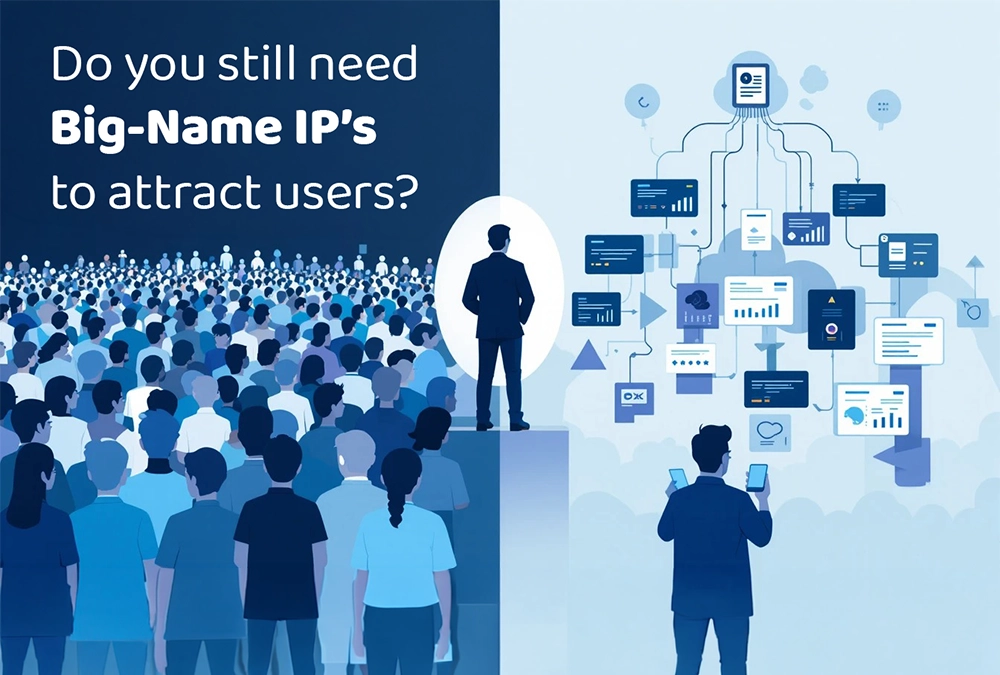
It is a reasonable request, and it is worth taking seriously rather than arguing with — because the instinct behind it is sound. What operators are really asking for is engagement: content their subscribers will open, enjoy, and come back to. A famous brand or a AAA title simply looks like the safest shortcut to that outcome. The question worth sitting with is not whether engagement matters — it plainly does — but whether IP is still the reliable shortcut to it that it once was.
Is an IP really an engagement guarantor?
The honest answer, looking at where players actually spend their time, is: not as reliably as we assume. In the genres that command the most attention and the most spending, the dominant titles overwhelmingly carry a brand of their own rather than a licensed one. The games people play the most built their pull from gameplay, live-operations, and design — not from a logo borrowed from film or television. Engagement and external IP are far less tightly linked than the request for IP assumes.
Which raises a fair follow-up. If IP is not the engagement guarantor it appears to be, why has it remained so firmly on every operator's wish list — especially in the VAS world?
Why IP earned its place — and why that's changing
The honest reason is that, for years, IP genuinely did guarantee something measurable: acquisition. A recognisable brand lowered the cost of bringing users in, and in a subscription-driven VAS model, cheaper, higher-converting acquisition flows straight to the bottom line. That belief was not folklore; it had numbers behind it. In Sensor Tower's read of the 2020 market, IP-based games were only about 9% of titles yet captured roughly 23% of player spending and 17% of installs. If you set your acquisition assumptions in that environment, asking for strong IP was simply good business.
The reason to revisit those assumptions is not that they were wrong — it is that the machinery underneath user acquisition has changed on two fronts at once, and both fronts happen to be exactly where IP used to earn its premium.
The first shift is on the creative-production side, and it is the one that matters most. The single biggest cost of running modern acquisition is producing enough creative to find the few ads that actually work — and AI has collapsed that cost. As UA specialist Matej Lančarič puts it, AI "doesn't replace creativity, it enhances it… need 100 different ad concepts by tomorrow? Give an AI some prompts." His read on the year ahead is blunt: "creative quantity will win over quality — it's going to be a volume play." This matters because winning creatives are genuinely rare: AppsFlyer's 2025 study of 1.1 million creatives and $2.4 billion in spend found that in gaming the top 2% of creatives drove 53% of all spend. When the winners are that concentrated, the team that can generate and test the most variations finds them first — and AI has made generating that volume cheaper than it has ever been. An expensive licence buys you one strong starting point; AI tooling buys you a hundred shots at a stronger one.
The second shift is on the buying side. The algorithms that now run acquisition — AppLovin's AXON being the clearest example — target the users most likely to install and bid on each impression by its predicted value. They optimise on signal quality and creative performance; brand recognition is not one of the inputs. As the hosts of the Two and a Half Gamers podcast summarised it, "garbage signals equal garbage results" — the system rewards clean data and strong creative, not a famous name. It is no coincidence that Eric Seufert of Mobile Dev Memo tied AppLovin's 71% jump in advertising revenue in early 2025 directly to generative AI applied to ad creative. The buying engine and the creative engine are pulling in the same direction, and neither of them is looking at your IP.
Put together, acquisition has quietly shifted from which brand you licensed to how quickly and how widely you can produce and test creative the algorithm can run with.
What the evidence shows about IP today
You can see the shift in where IP does and does not show up. Analytics firm GameRefinery notes that none of the top-10 grossing casual Match3 games use any third-party IP — and that licensed titles in the genre exist but "none of them have hit it big, even when the IP matched the target audience perfectly." The most telling voices are the ones closest to the biggest IP successes. Writing about Monopoly GO — one of the most prominent licensed hits in the market — Matej Lančarič said he remained "skeptical about the power of the IP," crediting the game's results to execution and spend rather than the brand, and noting that the licence itself carries a roughly 20% royalty cost.
"IP cannot create success. It's a platform. It's an opportunity." — Scopely marketing leadership
From the people who run the most successful IP campaigns in the business, that is about as clear as it gets: a strong IP is a head start, not a guarantee.
A fair caveat
None of this means IP has stopped mattering. A well-loved brand can still lift trust and curiosity at the margin, and it is reasonable to assume there is some floor below which creative volume alone cannot carry your costs. What's honest to say is that no current, credible source puts a number on that floor, and the one hard figure we have for an IP premium is the six-year-old snapshot above — from a market that predates today's tools. The strong version of the old belief — that you need an expensive IP to acquire users efficiently — is the part the evidence no longer supports. The practical version is more useful: the premium an IP commands has narrowed to the point where, for most catalogues, the budget once reserved for licensing now does more work when it is spent on AI-driven creative and clean acquisition signals.
What this means for the next five years
If the request for IP is really a request for engagement, then the smart question for an operator is not which licence can we secure but which platform and catalogue will actually deliver engagement and acquire users efficiently without leaning on one. That is where the next several years will be decided. The platforms that win will be the ones carrying games with solid engagement rates, minimal friction, and strong gamification — games that hold players on the strength of the experience itself, not on a borrowed brand. The frictionless side of that — the no-card, carrier-billed checkout — we all take for granted in this market by now; the plumbing is table stakes. What increasingly sets a platform apart is the quality of the experience built on top of it. A popular IP, in that picture, becomes a welcome bonus rather than a precondition: nice to have, no longer a must-have.