How VAS distribution affects your App Store revenue
One question comes up in almost every conversation with a developer weighing up telco distribution: if my game lives inside a carrier's subscription service, am I just shuffling downloads around — cannibalising the App Store revenue I already have? It's exactly the right question to ask. Here's what a year of data says.
What the VAS gaming market actually is
In the value-added services (VAS) world, games are usually offered inside all-you-can-play (AYCE) subscription services, billed through direct carrier billing (DCB). The model is deliberately simple, and deliberately different from the App Store: no ads, no in-app purchases. For one recurring fee, a subscriber gets access to every game in the service. Keep paying, keep playing — cancel, and access ends; the games can no longer be used. It behaves less like the free-to-play App Store economy and more like a streaming subscription for casual games.
How the billing works
Direct carrier billing charges a purchase or subscription to the user's mobile bill or prepaid balance instead of a credit card. The operator already owns the billing relationship; DCB simply extends it to digital content like games, and for the user it is one tap with no card details. Its real advantage is reach: it works anywhere a mobile signal does, with no dependence on card ownership, bank accounts or any extra payment infrastructure. Operators typically take a larger cut of each payment than a card processor would — but that is more than offset by far lower checkout friction and much wider accessibility, especially in markets where cards are scarce but phones are everywhere.
The scale of the channel
Through this model we can reach over 150 subscription stores, together serving more than 200 million paying subscribers, in a market growing roughly 12% a year. A title that meets all of our KPI thresholds, given a favourable market situation, can reach a high five-figure monthly recurring revenue across our VAS channels combined.
But what does it do to your App Store numbers?
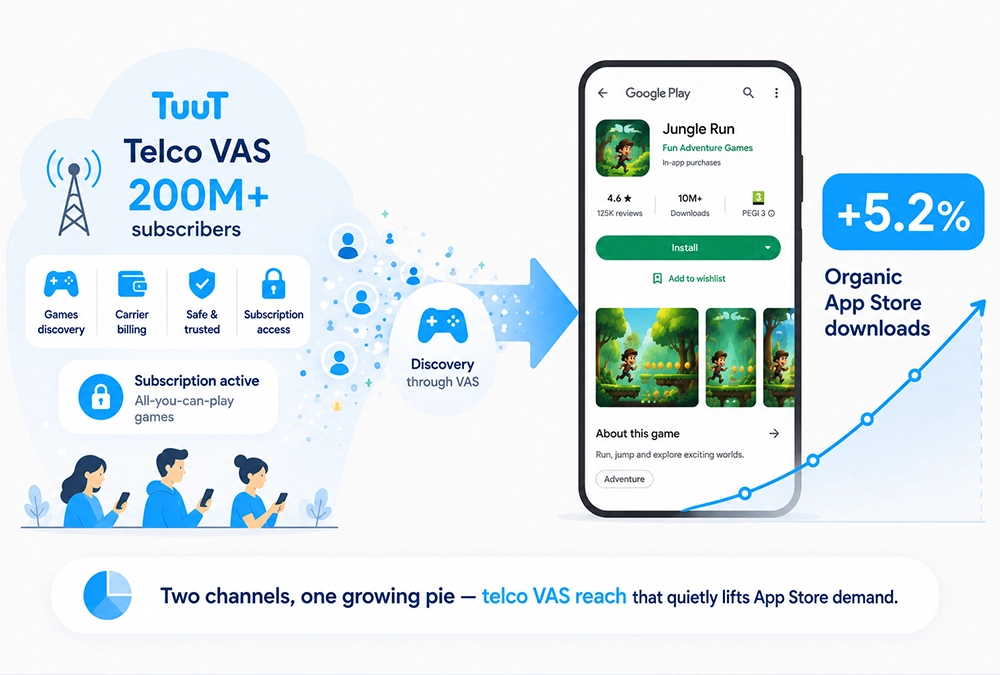
That reach is the appealing part — and it is also what raises the cannibalisation worry. If players can get your game inside a carrier bundle, do they stop downloading it from the App Store? To find out, we went to our partners and worked backwards: we lined their App Store download curves up against the periods when their VAS installs peaked, country by country. The pattern was consistent — App Store downloads and revenue held stable, or ticked slightly upward, in exactly the countries where VAS distribution was strongest. We then measured it properly: 15 games from our portfolio, tracked over a full year. The average result was a 5.2% increase in organic App Store downloads across the period.
Across 15 titles over 12 months, organic App Store downloads rose 5.2% on average — they didn't fall.
Why it doesn't cannibalise — and quietly lifts
The explanation is that these are two different audiences behaving in two different ways. Someone actively using a telco games offer isn't choosing between an App Store download and a carrier download; they take their content from the service, because they are paying for it — and for as long as they pay, they simply aren't active buyers on the free-to-play market. There is nothing to cannibalise, because they were never going to be an App Store customer in that window. At the same time, the carrier service works as a discovery surface. People who come across a game they want inside a closed telco offer they'd rather not pay for tend to do the obvious thing: they search for it and get it directly, from the App Store. The VAS placement has effectively marketed the title to an audience the App Store's own ranking never reached — and a slice of that demand flows straight back to your store listing.
The takeaway
Telco VAS distribution isn't a substitute for your App Store presence; it's a parallel channel — a paying subscription audience you monetise directly, plus a discovery effect that nudges organic App Store installs up rather than down. For the portfolio we measured, adding VAS distribution didn't cost App Store revenue. It added a new revenue line and, on average, a 5.2% organic uplift on top.